
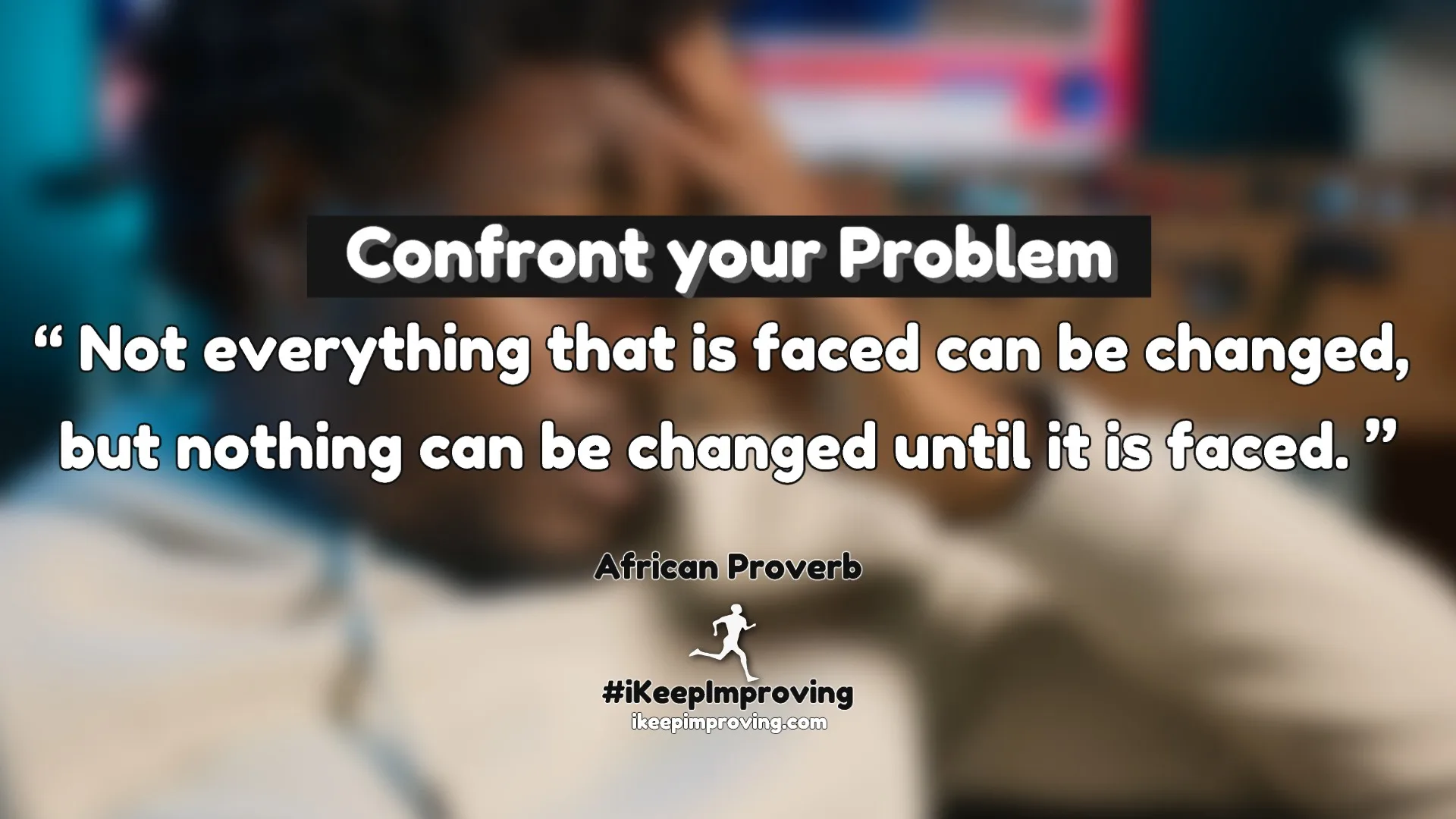
Confront your Problem
African Proverb
This statement, is built on a careful distinction between two very different claims that are easy to confuse. The first half acknowledges a hard limit honestly: confronting a problem directly does not guarantee you can fix it. Some circumstances, a diagnosis, a loss, another person’s choices, a past event, remain unchangeable no matter how clearly you look at them or how much courage you bring to facing them. This is not a small concession, it is an admission that facing reality is not magic, and that honesty alone does not always produce control over outcomes. The statement refuses to oversell confrontation as a guaranteed solution.
The second half, though, makes an equally firm claim in the opposite direction, that avoidance guarantees failure even where facing the problem would not have guaranteed success. Nothing can be changed until it is faced means that whatever chance of change does exist, however small, is completely inaccessible as long as the problem stays denied, minimized, or looked away from. Avoidance does not preserve the possibility of change for later, it forecloses it entirely in the present. This is the harder, more demanding half of the statement, because it removes the comfort of denial as a safe holding position, denial is not neutral, it is the one guaranteed way to ensure nothing improves.
Put together, the two halves describe the actual, unglamorous shape of real change. Facing a hard truth is not framed as a guarantee of victory, which would be naive, but it is framed as the only entry requirement for any possibility of progress at all, which is sobering rather than comforting. As motivation, the value of holding both halves at once is that it removes two common excuses simultaneously, the fear that facing something is pointless because it might not fix anything, and the hope that avoiding something is safe because at least nothing gets worse. The statement insists that facing reality is necessary but not sufficient, which is a harder, more honest standard than most people apply to their own avoidance, and a more useful one than blind optimism about confrontation alone.
Walk into the deep



G



Conversations
You must be logged in to comment on this article.
Log In / Register