
Accumulate concentrated Knowledge
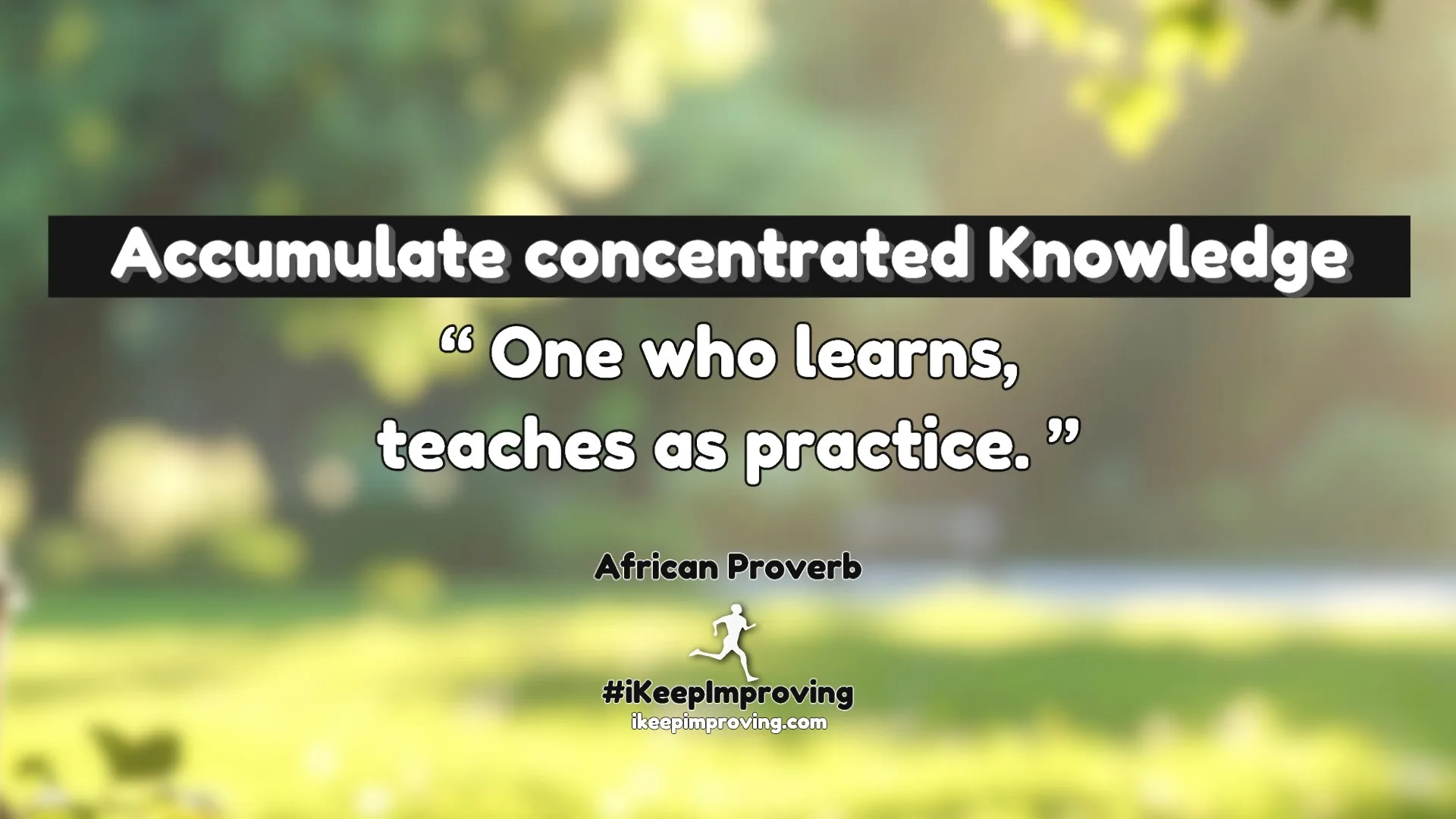
African Proverb
This phrase points to a well documented but often overlooked relationship between learning and teaching, that the two are not separate stages, first absorbing knowledge, then later passing it on, but are actually part of the same continuous process. The proverb’s underlying claim, he who learns, teaches, suggests that genuine learning is rarely complete until it has been articulated to someone else. Holding information passively, the way a book holds it on a shelf, is different from understanding it well enough to explain it, answer questions about it, and apply it to situations the original source never covered. Teaching forces a kind of compression and clarity that private study alone usually does not, because explaining something exposes every gap, every assumption, and every place where your understanding was more superficial than it felt.
“Accumulate concentrated knowledge” adds a second idea, that not all learning is equally valuable, some of it is diffuse and quickly forgotten, while some becomes dense, durable, and genuinely usable. The proverb suggests that the act of teaching, of treating each new thing you learn as something you will eventually need to explain to someone else, is what concentrates knowledge rather than letting it stay diluted and easily lost. A person who learns purely for private consumption tends to retain knowledge loosely, in fragments that fade once the immediate need passes. A person who learns with the intention of eventually teaching it tends to organize that same knowledge more tightly, building connections, examples, and structure that make it far more durable and far more transferable later.
As motivation, this idea reframes teaching not as something reserved for experts who have finished learning, but as a tool available to anyone at any stage, a practice you can apply immediately to whatever you are currently studying. You do not need to wait until you have mastered a subject to start explaining pieces of it to others, in conversation, in writing, in mentoring someone slightly behind you. Each attempt to teach something half learned reveals exactly where your own understanding is thin, and forces you to close that gap in a way passive review rarely does. The proverb’s deeper claim is that teaching is not the reward you receive after learning is finished, it is one of the most effective practices for making sure the learning actually sticks in the first place.
Walk into the deep




G



Conversations
You must be logged in to comment on this article.
Log In / Register