
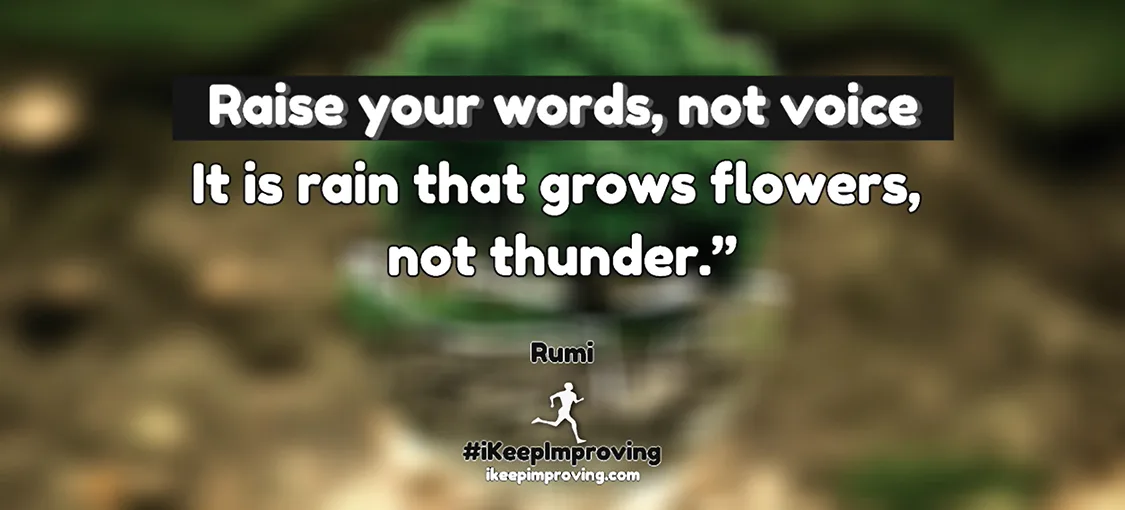
Raise your words not voice
Rumi
This is one of Rumi’s quote, built on a simple agricultural metaphor: thunder is loud and dramatic, but it produces nothing on its own. It is the quiet, sustained rain that actually nourishes seeds into flowers. Applied to human communication, the metaphor likens that volume and force are theater, not substance. Shouting or raising your voice in an argument signals a need for dominance rather than a desire to persuade, and it tends to trigger defensiveness in the listener rather than openness. Real influence, the kind that changes minds, repairs relationships, or moves people to act, comes from words chosen carefully and delivered steadily, the conversational equivalent of rain soaking into soil rather than a storm flattening whatever it touches.
The phrase “raise your words, not voice” pushes this further. It is not telling you to be passive or silent, but to redirect your energy. If you feel the urge to escalate, that energy should go into sharpening what you say, through better reasoning, more precision, more honesty, rather than into how loud or aggressive you sound. This reframes conflict itself. The instinct to get louder when you feel unheard is usually counterproductive, since it makes you harder to listen to, not easier. A quieter, more deliberate communicator often holds more real influence in a room than someone dominating it with volume, because people remember how an interaction made them feel long after they have forgotten who seemed to “win” it.
As motivation, this line is useful precisely because it reframes restraint as strength rather than weakness. In a culture that often rewards the loudest voice, the quote suggests that lasting impact on a relationship, a team, a child, or a stranger comes from consistency and gentleness applied over time, much like rain that falls repeatedly and patiently rather than once and violently. It is a quiet rebuke to the idea that intensity equals effectiveness, and an invitation to measure your words by what they grow in another person, not by how forcefully they are delivered.
Walk into the deep



G



Conversations
You must be logged in to comment on this article.
Log In / Register