
The River That Does Not Strive – What the Tao Te Ching Still Teaches Us
Legend says that Lao Tzu, an old keeper of the royal archives in the Zhou court, grew weary of a world falling into disorder. He climbed onto a water buffalo and rode west toward the mountains, intending to vanish from history. At the Hangu Pass, a gatekeeper named Yin Xi recognized him as a sage and refused to let him leave until he wrote down his wisdom.
So Lao Tzu sat and wrote about five thousand characters. Then he rode through the gate and was never seen again.
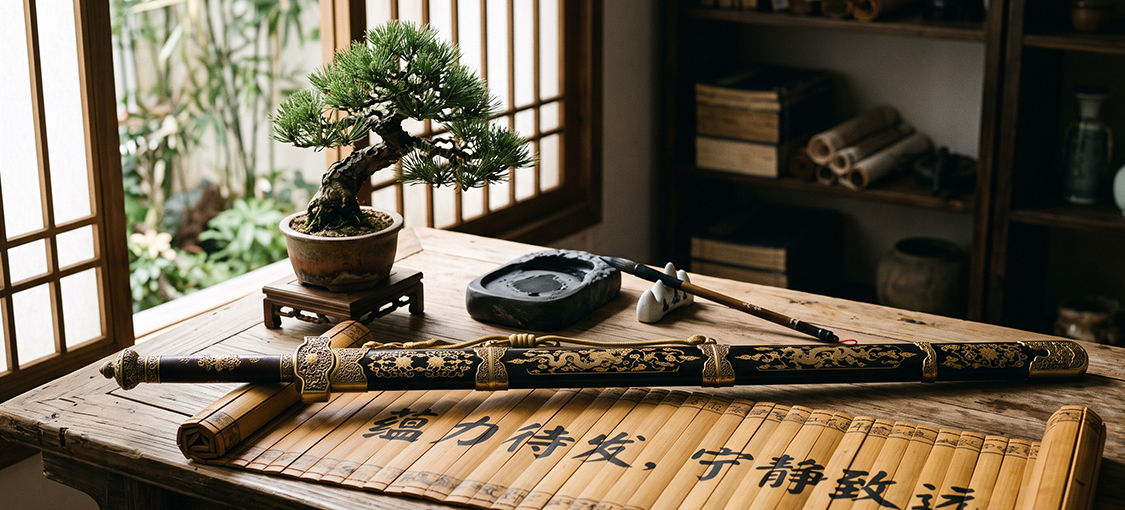
Whether the story is true hardly matters. The book he left behind, the Tao Te Ching (roughly, The Classic of the Way and Its Virtue), became one of the most translated works in human history. Its 81 short chapters are part poetry, part philosophy, and part quiet advice to rulers. It is the foundational text of Taoism, and it has shaped Chinese art, medicine, martial arts, and politics for more than two thousand years.
Walk into the deep
Where Sun Tzu teaches how to win, Lao Tzu asks a stranger question: what if the greatest strength is not trying so hard?
One: The Way (Tao)
The Tao That Cannot Be Named
The book opens with a paradox. The Tao that can be spoken of is not the eternal Tao. The name that can be named is not the lasting name.
From the very first line, Lao Tzu warns us that words will fail. The Tao is the source of all things, the pattern beneath the universe, the way nature moves. Yet it cannot be grasped, defined, or held. It is nameless, formless, and silent. Everything flows from it, and everything returns to it.
Rather than explain the Tao directly, Lao Tzu points toward it through images: a river, a valley, an uncarved block of wood, the mother of all things. He invites the reader not to understand the Way intellectually but to sense it, the way one senses the season changing.
The Dance of Opposites
When people call something beautiful, ugliness is born. When they call something good, the not-good appears alongside it.
Walk into the deep
Lao Tzu sees the world as a play of complementary pairs: long and short, high and low, sound and silence, before and after. Each gives meaning to the other. This is the spirit later captured in the familiar yin and yang symbol. Nothing is fixed; everything turns into its opposite in time. The full moon wanes. The bent tree straightens. The emptied cup is filled.
Wisdom, then, is not clinging to one side but understanding the movement between them.
The Usefulness of Emptiness
One of the book’s most famous images appears in Chapter 11. Thirty spokes meet at a wheel’s hub, but it is the empty center that makes the wheel useful. Clay is shaped into a pot, but the hollow inside is what holds water. Doors and windows are cut into walls, and it is the empty space that makes a room livable.
What we have gives us advantage, Lao Tzu suggests, but what we lack gives us use. A mind too full of opinions has no room for learning. A schedule with no space leaves no room for life.
Be Like Water
No image appears more often in the Tao Te Ching than water.
Walk into the deep
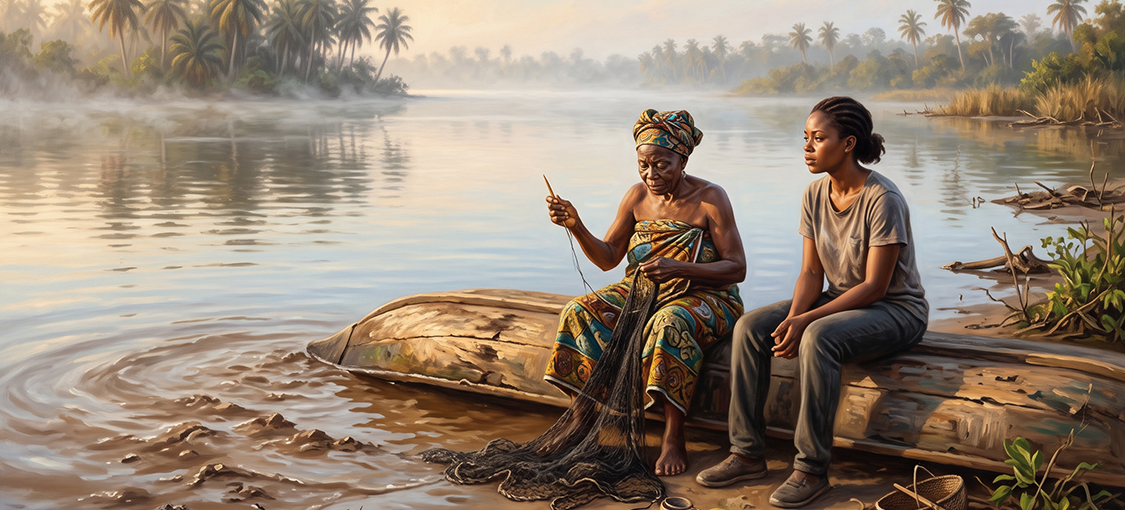
The highest good, Lao Tzu says, is like water. It nourishes all things without competing with them. It flows to the low places that others scorn. It is the softest and weakest thing in the world, yet nothing is better at wearing down the hard and strong.
Water teaches the whole philosophy in a single substance: humility, patience, persistence, adaptability, and power that works without force. It does not argue with the rock. It simply keeps flowing, and over time the rock becomes a canyon.
Two: Virtue and Power (Te)
Wu Wei: Effortless Action
The central practice of the Tao Te Ching is wu wei, often translated as “non-action” or “effortless action.” It does not mean laziness or doing nothing at all. It means acting in harmony with the natural flow of things, without forcing, straining, or grasping.
Think of a skilled swimmer who moves with the current, a carpenter who cuts along the grain, or a gardener who waters and waits rather than pulling at seedlings. The Tao does nothing, Lao Tzu says, yet nothing is left undone.
In practice, wu wei means doing what is needed, when it is needed, and then letting go. Do your work, then step back. That, he says, is the way of heaven.
The Uncarved Block
Lao Tzu repeatedly praises pu, the uncarved block: simple, natural, unshaped by cleverness and ambition. Before a craftsman carves it, the wood holds every possibility.
He warns that too many desires cloud the mind. The five colors blind the eye. The five tones deafen the ear. Racing and hunting madden the heart. Rare treasures lead people astray.
The sage, by contrast, embraces simplicity, reduces selfishness, and has few desires. Contentment itself becomes a kind of wealth. He who knows he has enough, Lao Tzu writes, is rich.
Softness Overcomes Hardness
At birth, people are soft and supple. At death, they are stiff and hard. Green plants bend in the wind; dry ones snap. So, Lao Tzu concludes, the stiff and unbending are companions of death, while the soft and yielding are companions of life.
An army that cannot bend will be defeated. A tree that cannot sway will break. This is not a philosophy of weakness but of resilience. The grass survives the storm that topples the oak.
Knowing Yourself
Lao Tzu offers one of his clearest lessons in Chapter 33. Knowing others is intelligence; knowing yourself is true wisdom. Mastering others is strength; mastering yourself is true power.
The outward conquests the world admires are, for him, lesser achievements. The deeper work is inward: seeing your own nature clearly and living in accordance with it.
The Three Treasures
In Chapter 67, Lao Tzu names three treasures he holds and guards:
- Compassion, from which true courage comes.
- Frugality (or simplicity), from which generosity becomes possible.
- Not daring to put oneself first in the world, from which true leadership grows.
Each treasure produces its seeming opposite. The gentle heart is brave. The one who keeps little has much to give. The one who stays humble is the one others choose to follow.
Three: The Sage and the Ruler
The Leader Who Is Barely Known
Much of the Tao Te Ching is addressed to rulers, and its advice is startling. The best leader, Lao Tzu says, is one the people barely know exists. Next best is one they love and praise. Next is one they fear. Worst is one they despise.
When the finest leader’s work is done, the people say, “We did it ourselves.”
He cautions against heavy-handed government. The more laws and prohibitions, the poorer the people become. The more cunning and clever the rulers, the more strange schemes arise. Governing a great nation, he says in a famous line, is like cooking a small fish: stir it too much and it falls apart.
Against Violence and Pride
Though written in an age of constant warfare, the book is deeply skeptical of force. Weapons are instruments of misfortune, Lao Tzu warns, and the sage uses them only when there is no other choice. Even then, victory should be treated like a funeral, never a celebration.
Pride and boasting are equally dangerous. Those who stand on tiptoe cannot stand firmly. Those who show off do not shine. Those who praise themselves earn no respect. The sage does not display himself, and therefore he is seen clearly.
The Journey of a Thousand Miles
Chapter 64 contains perhaps the most quoted line in the entire book: a journey of a thousand miles begins beneath one’s feet, with a single step.
The surrounding passage is about attention to beginnings. A towering tree grows from a tiny sprout. A nine-story terrace rises from a heap of earth. Deal with difficulties while they are still small. Handle what is fragile before it becomes unmanageable. Great things are done through small, patient actions taken at the right time.
Returning to the Root
Toward its close, the book returns to stillness. All things flourish, Lao Tzu observes, and then each returns to its root. Returning to the root is called stillness, and stillness is the return to one’s true nature.
The sage lives quietly, rests in the present, and is not troubled by gain or loss. He does not accumulate. The more he gives to others, the more he has. The way of heaven, the final chapter says, is to benefit and not to harm. The way of the sage is to act and not to contend.
The Enduring Lessons
Distilled to its essence, the Tao Te Ching offers a handful of quiet truths:
- Flow, do not force. Work with the grain of life, not against it.
- Soft is strong. Gentleness, patience, and flexibility outlast rigidity.
- Emptiness is useful. Leave space in your mind, your home, and your days.
- Simplicity is wealth. Knowing you have enough is the truest riches.
- Lead from behind. The best leaders empower others and take little credit.
- Begin small. Every great thing starts with a single step.
- Know yourself. Inner mastery outweighs any outer conquest.
That is why a small book left at a mountain gate still speaks to anxious, overworked, overstimulated readers today. It does not tell us to try harder. It invites us to breathe, to soften, and to trust the current.
The river does not strive, Lao Tzu reminds us. And yet it reaches the sea.



G


Conversations
You must be logged in to comment on this article.
Log In / Register